I am currently doing more swimming than usual in preparation for the 16km Marathon Swim Le Flow des Gabarriers this June.
Yesterday I enjoyed a swim with a friend who is preparing for the 33.3km SwimQuest adventure. She has been given a plan to follow in preparation and I thought I would do her session with her.
A 2km swim, 800m with a Pull Buoy and 6 x 100s building pace. The set uncovered some interesting insights that I knew would probably happen, yet the data was interesting to see.
I don’t normally use a Pull Buoy, but the use of pull buoys comes up regularly in conversation with swimmers that I coach, curious observations of how much faster some swimmers swim with them. Some may see the pull buoy as a crutch.
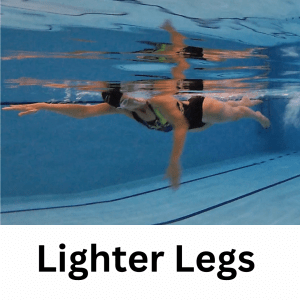
A swimmers priority for improvement in efficiency and speed is BALANCE and STABILITY, which is why for many swimmers they swim faster with the Pull Buoy. The Buoy raises their hips, lifting their legs higher in the water which eliminates drag and give a sense of lighter legs.
With the pull buoy between your legs unable to kick, any poor kick mechanics are veiled by the buoy. Many swimmers can be given a kick set and feel like they go nowhere or even backwards.
The pull buoy does not address your balance issues, only masks them, you can only fix these by improving your body position, weight distribution, and your ability to hold your upper and lower body together in alignment,
I have for many years been focusing on improving my own balance, stability and integrating the propulsive parts of the stroke, and was not surprised that I swam 10 seconds per 100m slower with the pull buoy, as it was hindering my ability to flick my toes from my hips to help drive the weight shift forwards and I felt disconnected.
If you use a pull buoy and it makes you swim faster, use the opportunity you have to feel the improvement in balance and alignment the buoy gives you. Pay attention to your core as you hold the pull buoy between your legs, don’t disengage the lower body, keep the lower body joining in with the rotation of the shoulders and hips.
If you are faster without the pull buoy, celebrate you have a well balanced and stable stroke and you can work on refining the propulsive parts of your strokes.
The next part of our session was about building pace. Many swimmers will have experienced trying to go faster and actually going slower.
Speed is a metric, an equation (Stroke Length x Stroke Rate). Balance and Stability are your first priorities for improvement, which will improve your Stroke Length (NO swimmers is far from these fundamentals), from here you can refine the co-ordination of your stroke, this will also help engage the larger muscle groups.
Speed is not guaranteed just by applying more power, and turning your arms over faster, in fact the opposite is often true, there is the play between tempo and stroke length and staying loyal to the technique points that make you swim faster.
The faster you go the water will only increase its resistance.
Power may win out for shorter reps – but for sustainable longer swims at a faster pace – you need to train smart and with technique focus.
Train attention, consistency and quality of movement, don’t reinforce ineffective movements. Go to the edge of your comfort zone, see where and when you ‘fall apart’ and let the fitness gains happen.
Rest is often best thought as a mental rest and reset – so you can maintain form throughout your swim.