I first met Kimberley 7 weeks ago, we have just finished a block of six lessons It’s been a fabulous journey for both of us and reading Kimberley’s experience is a reminder of how we can creatively get around not being able to swim, but how empowering and rewarding it is when we do learn and start to overcome our fears.
What is your swimming background and experience?
Despite being born and raised in the Philippines – a tropical archipelago with over 7,000 islands – I somehow never learned how to swim. Swimming simply wasn’t taught at school, and over time I developed a deep fear of water. I couldn’t put my head underwater without panicking, and floating felt completely unnatural.
What makes this more ironic is that I’ve spent a surprising amount of my life doing water-adjacent sports. I even managed to make the rowing team at an Ivy League School, proving that it’s entirely possible to move very fast on water without being able to survive in it.
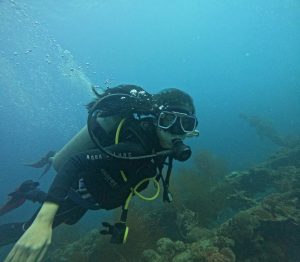
Later on, through a combination of optimism and creative problem-solving, I also managed to get a PADI license in Zanzibar – despite not being able to swim properly. Flippers were smuggled into the swim test, and Zanzibar was… accommodating.
I also took up kitesurfing, carefully engineering the risk by always wearing a buoyancy vest and only kiting in very shallow lagoons. I became very good at enjoying the idea of water sports while avoiding actual swimming at all costs.
On paper, I looked adventurous. In reality, I still wasn’t a swimmer.

What was your motivation for improving your technique?
Earlier this year, after years of prioritizing a demanding career in tech and finance, I decided to take a deliberate pause and focus on personal projects I had long ignored – including finally learning how to swim properly.
It felt like unfinished business, especially for someone who grew up surrounded by water yet feared it. I didn’t want to keep hacking my way around swimming – I wanted to feel calm, efficient, and genuinely confident in the water.
What led you to lessons with Susan?
I was inspired by the Total Immersion method after watching a TED Talk and learning more about its philosophy. The emphasis on efficiency, structure, and intelligent movement resonated deeply with me.
I’m very analytical by nature, and I love endurance sports like trail running and ultra-distance challenges. Total Immersion’s focus on efficiency over brute force felt like swimming designed for how my brain works.
Susan was the only certified Total Immersion coach I found in London – and I was genuinely excited to work with someone who truly understands and teaches the framework.
How did you feel about coming to your first lesson?
A mix of cautious optimism and genuine fear.
I understood the method intellectually, but I was very aware of my long-standing fear of water – especially deep water. I half-expected my body to freeze the moment my head went under, as it had many times before.
How have lessons improved your swimming?
The progress has been surprisingly fast and deeply rewarding.
When I started, I couldn’t float properly and my body position was completely unstable. Now, after just 6 sessions with Susan, I can float calmly, swim the full length of the pool, and – most importantly – stay relaxed in deep water.
One of my biggest breakthroughs was swimming into the deep end without panicking and being able to float there calmly. That moment alone felt like rewriting a lifelong story.
What do you like about the lessons and what’s a challenge?
What I love most is how incredibly detailed and thoughtful Susan’s coaching is. In every session, she meticulously films me swimming, and later the same day she sends the videos back with a clear, structured voiceover analysis. She breaks down my stroke, body position, balance, and timing in a way that’s incredibly easy to understand – and immediately actionable.
The videos aren’t just feedback; they’re a roadmap. Susan clearly summarizes what we worked on, what caused specific challenges, and exactly what I should focus on practicing between sessions leading up to the next one. As someone who’s very analytical – and admittedly a bit of a perfectionist – this level of structure and precision speaks directly to how I learn.
What’s especially impressive is how quickly she identifies the root cause of a problem and corrects it. Small tweaks make huge differences, and Susan spots them almost instantly.
The biggest challenge is still managing fear in new situations, particularly in deeper water – but having such clear feedback and a logical framework makes that challenge feel manageable rather than overwhelming.
What is your proudest swimming related achievement?
Floating calmly and swimming confidently in deep water – something that once felt completely impossible.
Going from panicking at the idea of putting my head underwater to swimming the full length of the pool has been genuinely life-changing, and I can’t wait to progress further from here!
Are you training for anything at the moment?
Right now, I’m focused on building technique, confidence, and endurance.
My goal is to complete my first open-water swim race next year – which feels mildly surreal considering where I started.
Funniest swimming moment?
The first time Susan gently encouraged me into the deep end, I panicked and ended up flailing my way to the side of the pool, clinging desperately to the lane ropes – the very wobbly, non-reassuring lane ropes – like they were my last hope.
Even in the moment, I knew I must have looked ridiculous, and I couldn’t help but laugh afterward. Susan calmly talked me down, and we turned the chaos into progress!
What are your future aspirations and dream goals?
To become a relaxed, confident open-water swimmer and complete my first race next year.
Longer term, I want swimming to be a lifelong practice – efficient, meditative, endurance-based, and joyful – rather than something I fear or “hack” my way around.
Any other comments from your learning experience?
Susan is the first swim coach who has truly helped me move past fear and make real, lasting progress.
Each session brings a small breakthrough – a shift in understanding, a technical tweak, or a moment of unexpected calm. Learning to swim properly has been one of the most satisfying personal projects I’ve taken on, and I’m excited to see just how far this journey can go.
Thanks for everything, Susan!